


Category: Anti-Perspirant Deodorant
An Enaiblex Agentic Commerce Optimization (ACO) Benchmark:
Scoring leading brands in the category
September 2026
Country: USA
Brands Scored: Certain Dri, Carpe Clinical, SweatBlock Clinical, Duradry Clinical
Relevant Retailers: Amazon, Walmart, Target, CVS, Walgreens
Specific shopping assistants: Alexa for Shopping, Sparky etc.
Disclosure: Enaiblex is an established expert in optimizing brand content to win with shopping assistants. Brands such as the ones mentioned here are our typical clients. None of the brands in this set have used our services at time of writing this report.
The verdict
We scored the top 4 products in the USA APDO category on how well their product content works for AI shopping assistants. The best score was 60 out of 100. The ACO threshold that matters is 85. Nobody is close, including Certain Dri, the category’s biggest name by market share, which scores 32.
As shopping agents increasingly influence product discovery and recommendation, the gap between today’s content and agent-ready content remains significant. Across this category, brands are still optimizing primarily for human shoppers rather than for the AI systems that now interpret, compare and recommend products.
Enaiblex ACO Scores – APDO
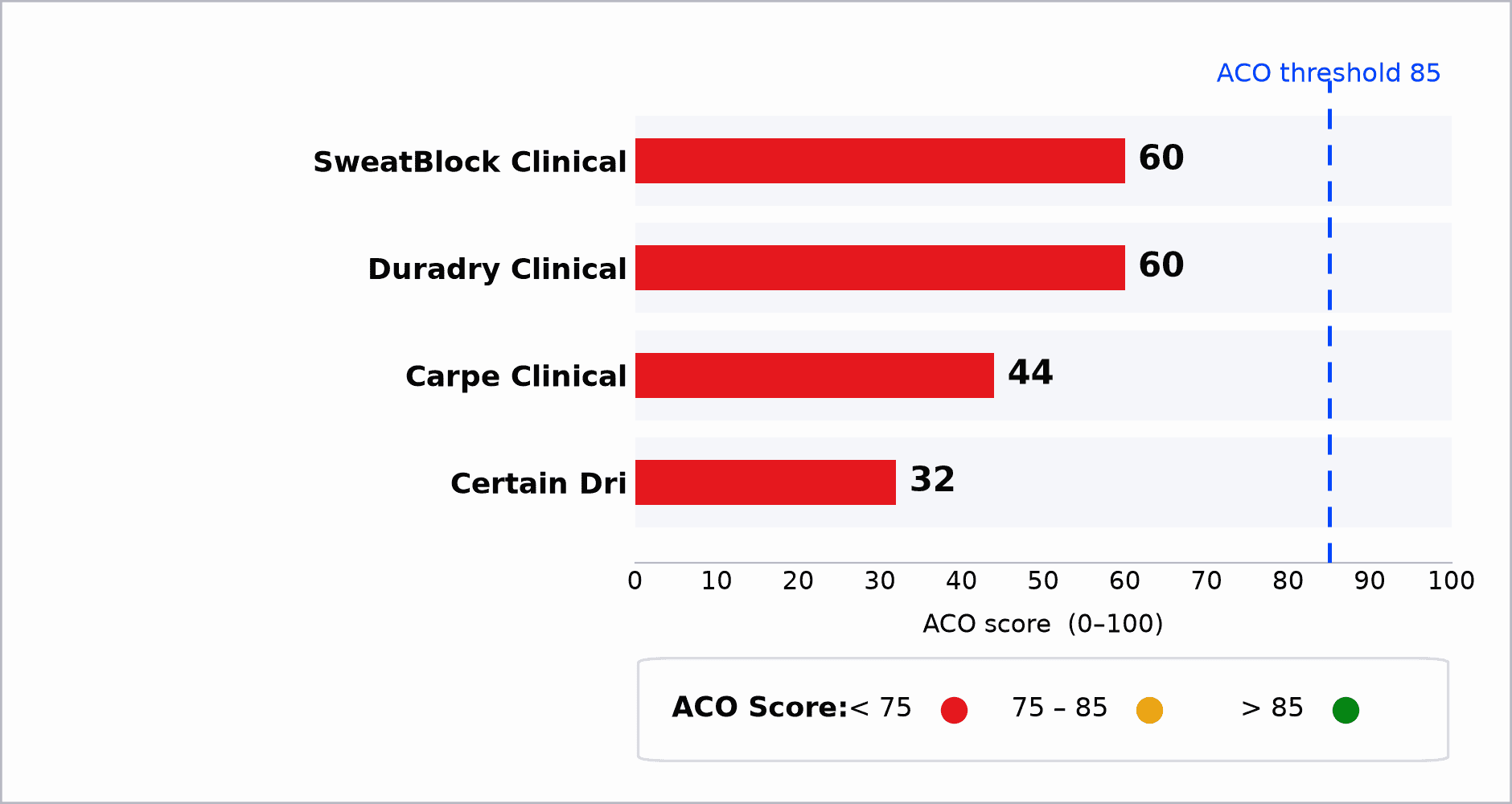
Enaiblex ACO Scores, APDO, USA. Source: Enaiblex.
Key Takeaways for your next leadership meeting
- The category has no incumbent to displace: The spread between the lowest ACO Score (Certain Dri, 32/100) and the highest (SweatBlock and Duradry, tied at 60/100) is 28 points — but the more important number is that even the category leaders sit 25 points below the 85-point threshold where content stops being a barrier to commercial performance. There is no brand in this set that has earned agent trust. The first brand to 85 sets the standard for the entire clinical antiperspirant category across Amazon, Walmart, Target, CVS, and Walgreens.
- This is not a search-optimization gap — it is an AI shopping agent trust gap: Conventional SEO asks whether a listing is findable. Agentic Commerce Optimization asks whether a shopping agent can extract, compare, and trust the information well enough to recommend the product to a specific shopper with specific needs. Those are different systems with different requirements. A listing that ranks well in keyword search can still score 32/100 on ACO because the information that earns agent trust — structured attributes, feature-to-benefit linkages, answers to comparison questions — sits in images and marketing copy that agents cannot parse.
- The market share leader is not the ACO leader, and that gap is commercially significant: Certain Dri holds the largest share in the clinical antiperspirant category, but its ACO Score of 32/100 is the lowest in this benchmark set. Brand equity built through decades of consumer marketing does not transmit automatically to AI shopping agents. An agent evaluating a shopper’s query about excessive sweating or hyperhidrosis has no memory of Certain Dri’s heritage — it reads the listing, and what it finds is a 6/50 on Shopper Query Coverage and a structurally incomplete PDP. A challenger brand that clears 85 first will be recommended more often than the market leader, regardless of market share.
- The gap to 85 is a first-mover opportunity, not a fixed disadvantage: Ecommerce contributes 30–50% of overall category sales in personal care, and the Enaiblex ACO Score is validated across 200+ SKUs where crossing 85 correlates with measurable sales growth. None of the four brands have claimed that position. The content rewrite required to reach 85 is achievable — the gaps are informational and structural, not platform or product limitations. The brand that moves first earns stronger agent recommendations, which feeds back into rank and visibility in a compounding flywheel.
- The root cause is informational, not stylistic — and the missing answers are specific: The largest driver of low scores across this category is not writing quality; it is the absence of structured answers to the questions shoppers actually ask. Three high-intent queries go unanswered across all four listings: whether the product reduces body odor, whether it functions as both an antiperspirant and a deodorant, and whether it will leave white marks on clothing. Beyond those, agents cannot find clear answers on active ingredient concentrations, the mechanism linking aluminum-based actives to sweat reduction, nighttime versus daytime application rationale, or how clinical-strength products differ from standard antiperspirants. These are not obscure questions — they are the decision criteria that determine purchase.
- Closing the gap is a content rewrite, not a platform migration — but the cost of moving second compounds: No brand in this set needs a new product, a new retailer relationship, or a new technology stack to reach 85. The fix is structured text: feature-to-benefit linkages, a complete attribute matrix, answers to the category’s core comparison questions, and efficient use of available character length. What makes timing matter is the flywheel: the first brand to clear 85 earns more agent recommendations, which generates more purchase data, which reinforces agent confidence in that brand. Moving second in a category where no one has yet moved means the cost of delay is not linear — it compounds with every week the threshold goes unclaimed.
Why Agentic Commerce Optimization?
Ecommerce sales growth is driven by 3 levers:
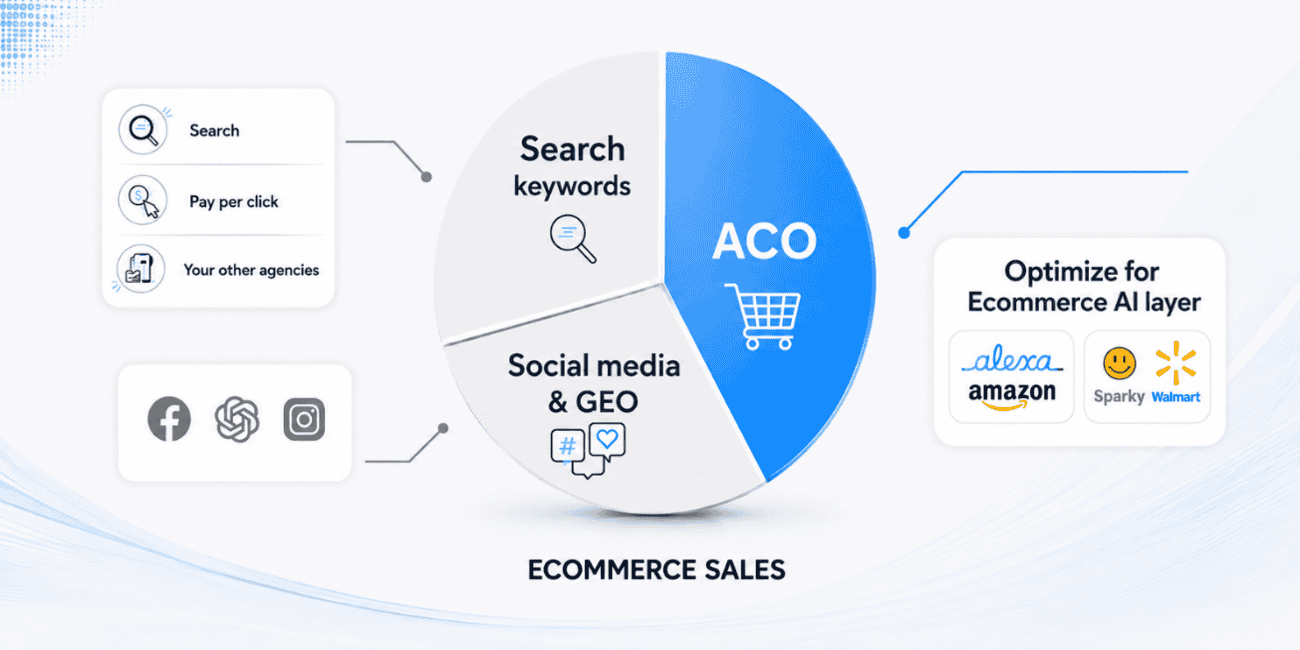

Two of the three levers are familiar: search (keywords, PPC, retail media) and social & GEO (social content and generative-engine visibility for brand discovery outside the platform). The third, and now an increasingly important metric, is how well a product’s own listing performs inside the AI layer ecommerce platforms have built on top of search: Alexa for Shopping, Walmart’s Sparky.
Ecommerce platforms no longer run on simple keyword search. They run AI models that read a shopper’s full context (need, constraint, budget, prior purchase) and assemble an answer.
ACO wins recommendations: the moment the AI layer decides which product to put in front of the shopper, or in their cart. A brand fully optimized for search and social can still lose at this step, because the system making the call is reading the listing itself, not the marketing that drove the shopper there.
What is happening on ecommerce platforms?
There are two key areas brands are losing out on in the era of agentic commerce:
One: you never enter the consideration set. When a shopper asks an AI shopping agent for “antiperspirant that works as deodorant too”, “clinical antiperspirant that won’t leave white marks on clothes” the agent doesn’t browse like a human. It breaks the request into a set of decision criteria and shortlists product listings that resolve those criteria in text it can extract.
If yours doesn’t state them, buries them in prose, or leaves them in an image, you aren’t retrieved. Your product can be the best answer to that query and never appear in it.
Two: you get the visit and lose the sale. The shopper lands carrying three or four doubts. “Does this help reduce body odor?” “Does this work as both an antiperspirant and a deodorant?” “Will this leave white marks on my clothes?” Unanswered, they return to the comparison set and buy from whoever answered. Imagery and review volume don’t close a gap the shopper is actively asking about.
Both failures look identical in your reporting: soft traffic, soft conversion, share drifting away. They are content problems, and both are fixable.
Products that clearly communicate relevant information are more likely to be recommended. Products with incomplete or poorly structured content force the agent to infer, reducing confidence in recommending them.
What we measured
| The Agentic Commerce Optimization (ACO) Score is Enaiblex’s proprietary 0–100 framework for measuring how well a product listing is optimized for AI shopping agents on ecommerce platforms. Above 85, content on your ecommerce pages is no longer what’s holding the product back. This framework has been applied to 200+ SKUs across the US and UK and has seen consistent results as depicted in the next section. |
Unlike traditional ecommerce metrics, the Enaiblex ACO Score evaluates content across two dimensions: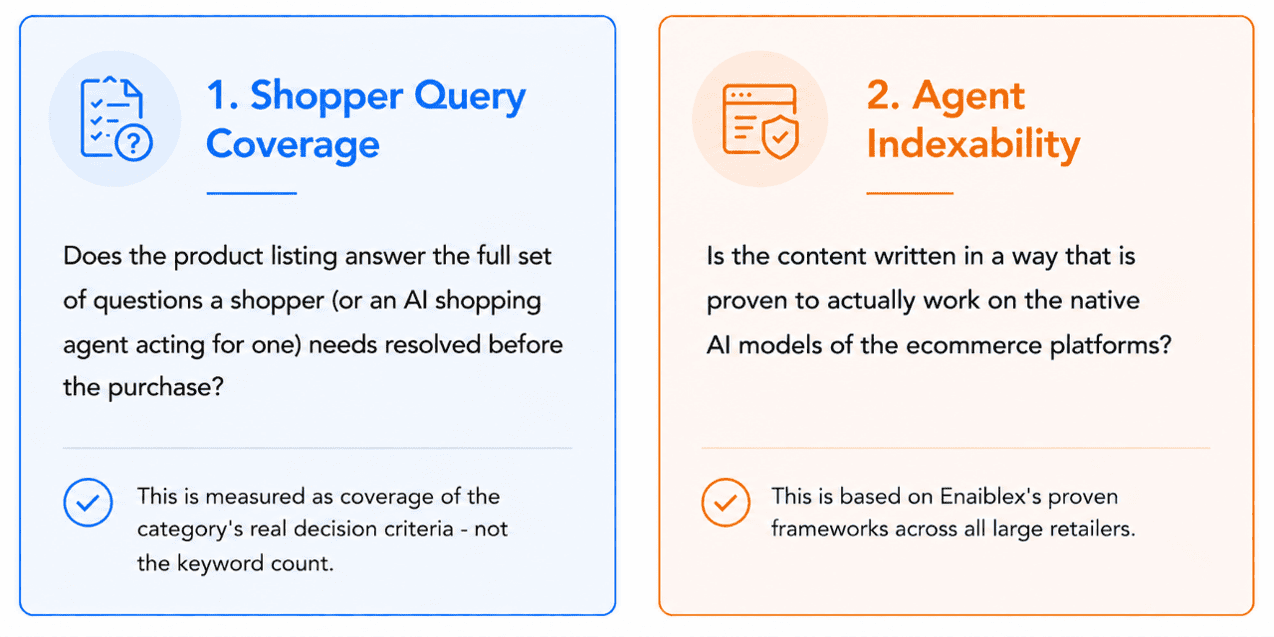
Why is 85 the number?
An Enaiblex ACO Score of 85 represents the point at which ecommerce content is no longer the primary constraint to recommendation by shopping agents. Above this threshold, sales response becomes dependable since product listings consistently provide sufficient information and structure for AI systems to confidently understand and recommend them to shoppers. Because that’s where the sales response becomes dependable.
The correlation is clear in real market data across multiple brands and categories on Amazon USA – as Enaiblex ACO scores increase, so does sales growth.
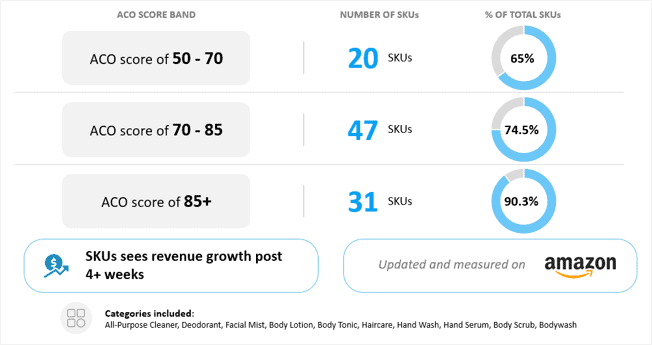
Enaiblex ACO score movement and observed sales response across USA. Source: Enaiblex.
The pattern that matters: bigger the gap closed, bigger the commercial return.
While pricing and availability continue to influence sales, improving ecommerce content and crossing 85 removes one of the largest controllable barriers to product recommendation.*
*These are in-market results, not a lab. Price and seasonality weren’t held constant. Across the wider 200+ SKU dataset, SKUs that cross 85 show a sales response materially more often than those that don’t and treat it as a strong operational signal, not a guarantee.
Analysis
The brands benchmarked in this report all remain below the threshold. The following sections explain where points are lost and the highest-impact opportunities to close the gap.
| Rank | Brand / SKU | Enaiblex ACO Score | Pillar 1: Shopper Query Coverage | Pillar 2: Agent Indexability |
| 1 | SweatBlock Clinical | 60 | 26 | 34 |
| 2 | Duradry Clinical | 60 | 31 | 29 |
| 3 | Carpe Clinical | 44 | 21 | 23 |
| 4 | Certain Dri | 32 | 6 | 26 |
Pillar Breakdown: The overall Enaiblex ACO Score is an average of two pillars, weighted equally: Shopper Query Coverage and Agent Indexability.
Shopper Query Coverage
This pillar evaluates whether a product listing provides enough information for both shoppers and shopping agents to confidently compare products and make a purchase decision. High-scoring listings answer not just what a product is, but who it’s for, when it should be used, why it should be chosen, and how it differs from alternatives.
Common information gaps across the category: Across the four benchmarked listings, several high-intent shopper questions remain unanswered or only partially answered.
Examples include:
- Can I use this with a separate deodorant?
- Is this effective in hot summer weather?
- Does the formula help minimize redness?
- Can this protect my clothes from sweat stains?
These are the types of contextual questions shopping agents increasingly use to compare products and make recommendations. When product listings do not provide clear answers, agents have less evidence to confidently recommend that product to shoppers.
Agent Indexability
Agent Indexability measures how effectively a product listing is structured for AI shopping agents. High-scoring listings clearly communicate product attributes, benefits and differentiators in a way that enables agents to retrieve, compare and recommend products with confidence.
Common indexability gaps across the category: Across the four benchmarked SKUs, the most common issues reducing agent indexability are:
- Inefficient use of available character length
- Share of Attributes could not be compared: no attribute matrix was produced for this listing.
- Core product type or category is underrepresented in the content
- Functional benefits are insufficiently linked to the features that enable them.
These issues reduce the amount of structured evidence available to shopping agents when comparing similar products.
Category Level Insights
- All four brands sit on the same side of the 85-point threshold. The spread between the lowest score (Certain Dri, 32/100) and the highest (SweatBlock and Duradry, tied at 60/100) is 28 points — but the more important number is that even the highest-scoring brands sit 25 points below the line where content stops being a barrier to commercial performance. No brand in this category has earned agent trust. The first to reach 85 sets the standard across Amazon, Walmart, Target, CVS, and Walgreens simultaneously.
- Agent Indexability is the primary bottleneck across the category, not Shopper Query Coverage. Three of the four brands score lower on Indexability than on Coverage, and the one exception — Certain Dri — scores catastrophically low on both. The implication is that the category’s content problem is structural before it is informational: the information that does exist is not formatted in a way that lets an agent extract, compare, and trust it. Rewriting copy without restructuring the feature-to-benefit architecture will not move the ACO Score meaningfully.
- The same three shopper questions go unanswered across all four listings. Whether the product reduces body odor, whether it functions as both an antiperspirant and a deodorant, and whether it will leave white marks on clothing are the category’s core comparison questions — and none of the four PDPs answer them in a form an agent can extract and relay. This is not a brand-by-brand gap; it is an industry blind spot. The brand that answers all three clearly and structurally gains a first-mover advantage that compounds as agent recommendation data accumulates.
- One brand’s gap is different in kind, not just degree. Certain Dri’s 6/50 on Shopper Query Coverage places it in a separate category from the other three brands: there is almost no structured informational content for an agent to work with, not partial content that needs expanding. The other three brands have Coverage scores between 21 and 31 — meaningful gaps, but ones where existing content can be restructured and extended. Certain Dri’s Coverage gap requires building from near-zero, which is a different remediation task and a different timeline.
No brand has reached agent-ready content. All four brands remain below the ACO benchmark of 85, indicating that content is still limiting how effectively shopping agents can understand and recommend these listings.
Brand Level Insights
Certain Dri: 32/100 (Shopper Query Coverage: 6/50, Agent Indexability: 26/50)
The category’s market share leader scores last in this benchmark — and its 6/50 on Shopper Query Coverage means agents have almost nothing to work with when a shopper asks whether Certain Dri controls odor, prevents clothing stains, or works as a deodorant.
The inversion at the heart of Certain Dri’s position is this: it holds the most brand recognition in the category and the lowest ACO Score in the benchmark. A 6/50 on Shopper Query Coverage is not a partial-content problem — it is a near-total absence of the structured answers agents need to recommend the product. When a shopper asks a clinical antiperspirant agent whether a product reduces odor, works as a deodorant, or leaves white marks on clothing, the Certain Dri listing provides almost nothing to work with. The Indexability score of 26/50 compounds this: the content that does exist — the 72-hour claim, the 15% aluminum chloride active, the nighttime application rationale — is not linked to the features that produce those outcomes, so an agent cannot construct a trust chain from ingredient to benefit to shopper need. Specific gaps include the complete absence of Sensitive Guard Technology and its botanical formula from the PDP (the current Amazon ingredient list reflects an older four-ingredient formula, not the current ten-ingredient formulation), no mention of the alcohol-free and water-based positioning, no reduced-frequency maintenance guidance, and no structured answer to whether the product functions as a deodorant or only as an antiperspirant. The mechanism behind nighttime application — that lower sweat output during sleep allows the aluminum chloride to form a more effective temporary plug in the sweat duct — is the kind of feature-to-benefit linkage that gives an agent confidence to recommend; it is absent. Because both pillars are critically low, there is no well-formed content layer to build from on Coverage — the fix requires building structured answers from the ground up, not expanding existing copy. The gap to 85 matters more than the gap to the category’s ACO leaders: closing 53 points on a listing that has partial indexability infrastructure but almost no coverage content means Coverage must be rebuilt as a priority, with Indexability restructured in parallel.
Carpe Clinical: 44/100 (Shopper Query Coverage: 21/50, Agent Indexability: 23/50)
Carpe Clinical is the only brand in this set with Leaping Bunny certification and a 20% aluminum-zirconium active at the FDA-permitted ceiling — but neither fact appears on its Amazon PDP, so agents recommending products to shoppers who care about either cannot find them.
What makes Carpe Clinical’s position distinctive is not the size of its gap but the nature of what is missing. At 44/100, it scores higher than Certain Dri on both pillars, and there is partial content to build from on both Coverage (21/50) and Indexability (23/50). The problem is that the most commercially powerful proof points — the ones that would differentiate Carpe from every other clinical antiperspirant in this set — are sitting on the brand’s own website and in third-party certification registries, not on the Amazon PDP where agents are doing their evaluating. The 20% aluminum zirconium tetrachlorohydrex gly concentration is the highest FDA-permitted level for this active and a direct substantiation of the ‘clinical strength’ claim; it does not appear on the PDP. Leaping Bunny independently lists Carpe in its cruelty-free program — a verifiable, third-party endorsement of the kind that gives agents confidence in a claim — and it is absent from the listing. The vegan and paraben-free claims, the first-order money-back guarantee, and the twice-daily application routine (including the warming instruction that addresses the recurring consumer complaint about rough application) are all present on the brand site and absent from Amazon. The consequence, as the Enaiblex framework identifies, is that an agent trying to resolve a shopper’s query about a clinical-strength, ethically positioned antiperspirant for excessive sweating cannot find the answers it needs to recommend Carpe with confidence — and defaults to whichever listing resolves those questions more cleanly. Indexability at 23/50 reflects the same structural problem: benefits are stated without being linked to the features that produce them, and the attribute matrix an agent would use for comparison does not exist. The value proposition is real; it simply does not reach the agent, and therefore does not reach the shopper.
SweatBlock Clinical: 60/100 (Shopper Query Coverage: 26/50, Agent Indexability: 34/50)
SweatBlock Clinical ties for the highest ACO Score in the category while simultaneously carrying the most consequential internal contradiction in the set: its PDP implies the stick treats hyperhidrosis, while the brand’s own FAQ says it does not.
Tying for the highest ACO Score in the category at 60/100 is a meaningful relative position, but SweatBlock Clinical’s data contains a specific content problem that no other brand in this set has: an active use-case contradiction embedded in the listing itself. The PDP connects the product to hyperhidrosis and excessive sweating when paired with DRIBOOST, while the brand’s own FAQ states plainly that the clinical stick alone is not effective for most excessive sweating and is intended for mild-to-moderate daily use. An agent trying to answer a shopper’s question about whether this product treats hyperhidrosis will find conflicting signals in the same listing — and when an agent cannot resolve a contradiction, it moves to a product that gives a cleaner answer. Resolving this architecture is not a minor copy edit; it requires restructuring the use-case logic so the stick’s appropriate positioning (everyday sweat and odor control, with DRIBOOST as the escalation path for heavier sweating) is unambiguous. Beyond that structural issue, the active ingredient concentration remains unresolved: the current brand page states 20% aluminum zirconium tetrachlorohydrex gly, while an older regulatory record lists 15.2%, and the PDP discloses neither figure. Agent Indexability at 34/50 is the strongest in the set, which means SweatBlock has more structural foundation to build on than any competitor — but the 26/50 on Coverage reflects that the information filling that structure is incomplete. The complete ingredient list, the motion-activated protection claim, the 100-day guarantee, and the allergen-exclusion data from SkinSAFE’s 91-rating assessment are all absent from the PDP. The gap to 85 is 25 points, and the path there runs through Coverage first: the Indexability infrastructure is relatively stronger, but it cannot do its job until the content it is meant to structure is actually present.
Duradry Clinical: 60/100 (Shopper Query Coverage: 31/50, Agent Indexability: 29/50)
Duradry Clinical scores highest on Shopper Query Coverage of any brand in this set — yet its Agent Indexability trails SweatBlock’s by five points, which means it has more information than any competitor but has not yet structured it in a form agents can extract and trust.
Coverage at 31/50 is the highest of any brand in this benchmark — which makes Duradry Clinical’s Agent Indexability score of 29/50 the more telling number. The information is closer to present than for any competitor, but it is not yet structured in a way that lets an agent extract and trust it. That asymmetry defines the nature of the fix: this is not primarily a content-creation problem, it is a content-design problem. The functional benefits that do appear in the listing — clinical sweat control, 90% naturally derived ingredients, talc-free and silicone-free positioning, dermatologist endorsement — are stated without being linked to the features that produce them. Ethylhexylglycerin’s role in odor-bacteria control, the mechanism by which the 20% aluminum zirconium active forms temporary sweat-duct plugs, and the rationale for the 2–4 swipe application instruction (the brand’s own user guide warns that overapplication can create apparent sweat marks) are all present in Duradry’s off-Amazon content and absent from the PDP in structured form. Specific gaps that compound the Indexability deficit include the heavy- and stress-sweat positioning that the brand explicitly uses on its own site but does not surface in the Amazon bullets, the 60-day brand guarantee versus the marketplace’s 30-day policy, and the scent description that stops at ‘Cool Citrus + Cedar’ rather than the fuller sensory profile the brand uses elsewhere. There is also an unresolved formula conflict — the DailyMed label and the brand’s ingredient page list materially different inactive ingredient sets — that needs to be reconciled before the listing can make credible ingredient-transparency claims. The commercial implication is direct: Duradry has more raw information available than any competitor in this set, but until that information is structured so agents can extract feature-to-benefit linkages and run comparisons, the Coverage advantage does not translate into agent recommendations.
| Why this matters commercially: this isn’t cosmetic. When a shopping assistant can’t extract a clear, evidenced answer to a shopper’s question, it moves on to another product that does. Every gap above is a point where these brands are handing the narrative to someone else. Closing both pillars to an Enaiblex ACO Score above 85 is what’s validated, across a 200+ SKU dataset, to correlate with sales growth. Until that threshold is cleared, none of these four brands are getting the full commercial return their products should earn on Amazon. |
| Have a Question? Get answers to the questions business leaders are asking about product visibility on ecommerce platforms and Agentic Commerce Optimization. → Explore the FAQs |
How we did this, and what to take with a pinch of salt
| What we scored | Four SKUs: Certain Dri, Carpe Clinical, SweatBlock Clinical, Duradry Clinical |
| Platform | Amazon Online Retail |
| Country | USA |
| Audit date | September 2026 |
| Method | Enaiblex ACO score, 0–100, across Shopper Query Coverage and Agent Indexability |
| Validation set | This methodology is validated with 200+ SKUs across categories, US and UK |
- Scores are at a point-in-time. Listings change, so do scores.
- One SKU per brand. These are not brand-wide scores and shouldn’t be read as such.
- The sales figures are observed in-market results, not a controlled experiment.
- The ACO methodology is proprietary to Enaiblex. Scores are reproducible under it but not independently audited.
- A low score says nothing about product quality, safety or efficacy. It measures the content record only.
Think a score is wrong? We’ll re-audit and republish with the revision dated. Book a demo.
| Cite as: Enaiblex (2026). Agentic Commerce Optimization (ACO) Benchmark: APDO, USA. Available at [insert URL]. |
Sources: Amazon Alexa for Shopping disclosures 2025–26; Adobe Analytics Q1 2026; Enaiblex ACO dataset.