


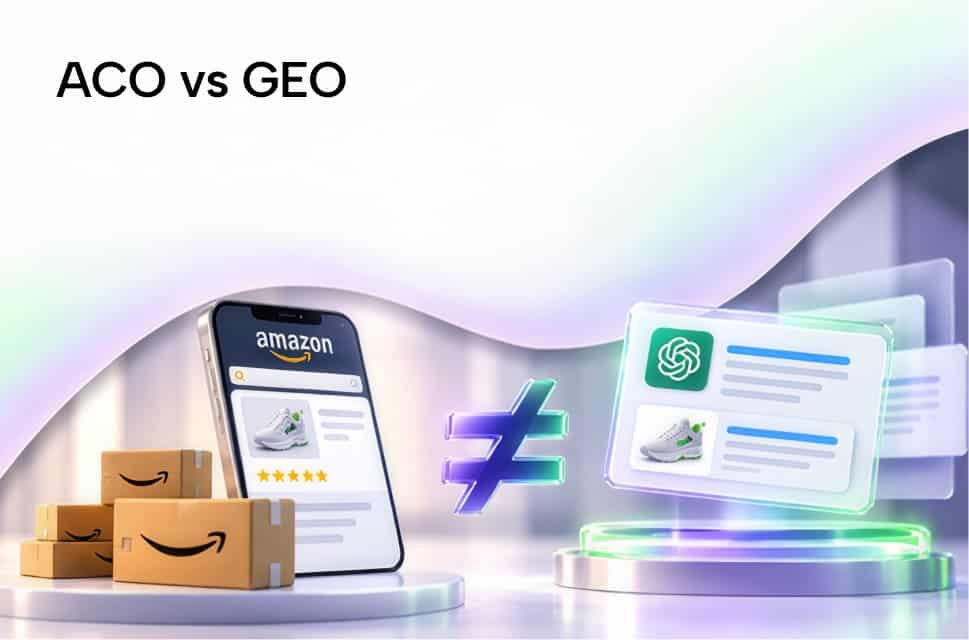
Generative AI has changed how people find things. A shopper can now ask an assistant to explain, compare, or recommend a product instead of typing keywords into a search bar and clicking through ten links.
That shift has created two separate challenges for ecommerce brands, and they get mixed up constantly.
One is about whether an AI assistant like ChatGPT or Gemini cites your brand when someone asks a general question. The other is about whether the AI layer built into a shopping platform, like Amazon or Walmart, actually recommends your product when someone is ready to buy.
These are not the same problem. They don’t use the same systems, and they don’t call for the same work.
What Agentic Commerce Optimization actually means
Agentic Commerce Optimization (ACO) is about the AI layer that ecommerce platforms now run underneath their own search and shopping experience.
Amazon has Alexa for Shopping and COSMO. Walmart has Sparky. These systems read and index product listings on their own platform, interpret what a shopper is asking for, and decide which products to surface as an answer.
ACO has nothing to do with whether a standalone assistant outside the platform knows your brand exists It’s about whether Alexa for Shopping, Sparky, or a similar system can parse your listing well enough to recommend it. That depends on the completeness of your product data: attributes, variants, use cases, compatibility, and so on.
“Which running shoes are good for long distance training and under $120?”$80
Asked on Amazon, that question gets answered by Alexa for Shopping, working from the product data sellers have provided. If your listing is missing cushioning or breathability details, Alexa for Shopping has less to work with, no matter how good your brand reputation is.
What Generative Engine Optimization actually means
Generative Engine Optimization (GEO) is about a different audience: standalone AI assistants like ChatGPT, Gemini, and Perplexity, answering broader informational questions.
“What should I look for in a running shoe if I have flat feet?”
That’s not a platform-specific shopping query. It’s a general question, and the assistant answering it is pulling from articles, guides, and brand content across the open web, not from a retailer’s product catalog.
GEO is closer to traditional SEO extended into AI-generated answers. It rewards clear, well-structured, authoritative content. It’s less about a single SKU and more about your brand’s expertise on a topic.
ACO is the lever most brands haven’t touched yet
Agentic Commerce Optimization | Generative Engine Optimization | |
Primary goal | Ecommerce content that wins with shoppers | Brand content that gets surfaced in general AI answers |
Content scope | Product listings on Amazon, Walmart, and similar platforms | Any web content: articles, guides, brand pages |
What it needs to satisfy | Shoppers, plus platform shopping agents like Alexa for Shopping and Sparky | ChatGPT, Gemini, Perplexity, and similar assistants |
Link to revenue | Direct, since it affects whether you surface during an active purchase | Indirect, since it builds awareness that may lead to a purchase later |
Most brands have spent years on traditional SEO and, more recently, on general AI visibility. Very few have spent any real time making sure Alexa for Shopping or Sparky can actually parse and recommend their products.
That gap is exactly why ACO matters right now. It sits directly on top of a purchase decision, not several steps upstream of one. A shopper asking Alexa for a recommendation is already shopping. If your product data is thin, incomplete, or poorly structured at that moment, a competitor’s listing wins the sale instead, even if your brand is better known.
Fixing that is one of the more direct ways to grow ecommerce revenue right now, and it’s largely untouched by most teams.
A few steps you can start on yourself:
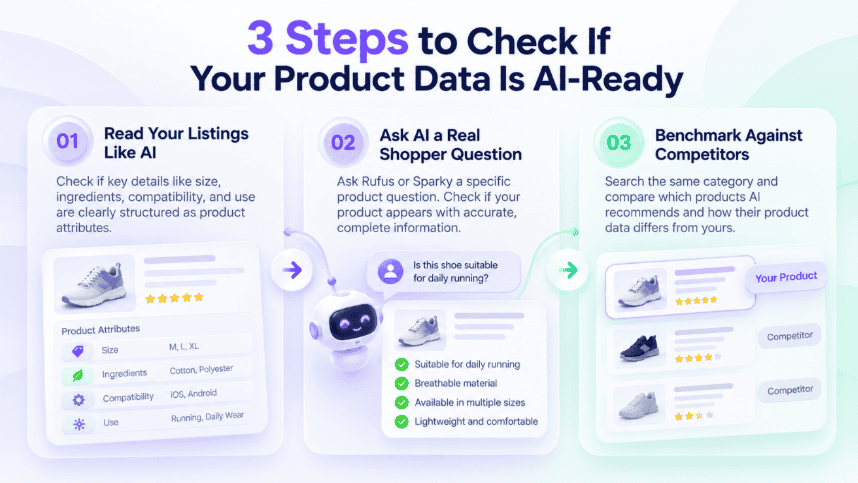
Read your top listings the way a shopping AI would. Pick a handful of your best-selling SKUs and check whether size, ingredients, compatibility, and intended use are present as structured attributes, not buried in a paragraph of marketing copy.
Ask the platform’s own assistant a real shopper question. Type a specific query into Alexa for Shopping and see what comes back. If your product doesn’t show up, or shows up with missing or wrong details, that’s a data gap, not a ranking penalty.
Look at how you stack up against competitors on the same platform. Search a category you compete in and note which listings the AI layer brings up as its answer. That tells you where you stand today, not where you assume you stand.
The main idea
ACO is still new enough that most ecommerce teams haven’t built a real process around it. That makes it one of the more underleveraged growth levers available right now: the brands that get their product data right for platform AI systems will start winning recommendations that competitors are currently missing out on.
Where Enaiblex fits in
The steps above will tell you roughly where you stand, but a clear benchmark helps more than a rough sense of it.
Enaiblex’s ACO Score gives brands exactly that: a way to check your standing against competitors in the same category. Brands scoring above the 85 threshold are winning in AI-driven commerce and building real capability in a space that’s moving fast. We’ve seen proven sales growth of over 15% in brands scoring above 85 on Enaiblex’s ACO Score, validated in market across 200+ SKUs.
Enaiblex works in exactly this product discovery and ranking layer, helping ecommerce teams close that gap across a full catalog rather than a handful of SKUs.
Book a demo with us to learn more!