
A surprising moment recently exposed a silent revenue killer for FMCG brands.
It revealed a critical gap in how brands approach the new era of AI search. While 73% of FMCG companies have invested heavily in digital product catalogs, recent data shows that only 28% of their products appear in AI shopping agent recommendations. [1]
The technology exists, but the strategy is missing. Most brands don’t yet understand how agents like ChatGPT, Gemini, or Perplexity select a winning product. While a digital catalog includes everything from high-resolution visuals to logistical SKU data, the current revenue killer is a content failure. While visuals attract humans, it is the structured text and machine-readable content that convince an AI agent to recommend you.
In this article, we focus on the specific text-optimization playbook that turns “ignored” products into “winning” recommendations.
The Hidden Economics of AI Decisions
AI shopping agents don’t just “search” like Google used to. They evaluate, filter, and recommend based on sophisticated algorithms that prioritize trust over keywords.
Recent analysis reveals that these systems look for three specific things before they recommend your brand:
- Structured Information: Can the AI easily read your specs?
- Doubt-Busting Content: Are you answering the critical questions that drive purchase decisions?
- Cross-Channel Consistency: Does your story match across every channel?
The benefits of getting this right are enormous. Brands with optimized Product Detail Pages (PDPs) see a 18–32% higher likelihood of appearing within the first 5 to 15 recommendations an AI gives a shopper [3]. Even better, proactive content that addresses shopper doubts reduces bounce rates by 12-27% [4].
The New Playbook: The Doubt-to-Conversion Framework
The real challenge isn’t just technical, it’s psychological. You need to understand what makes a shopper hesitate before they leave your site. This is why innovative brands are using the ‘Doubt-to-Conversion Framework’ to solve it.
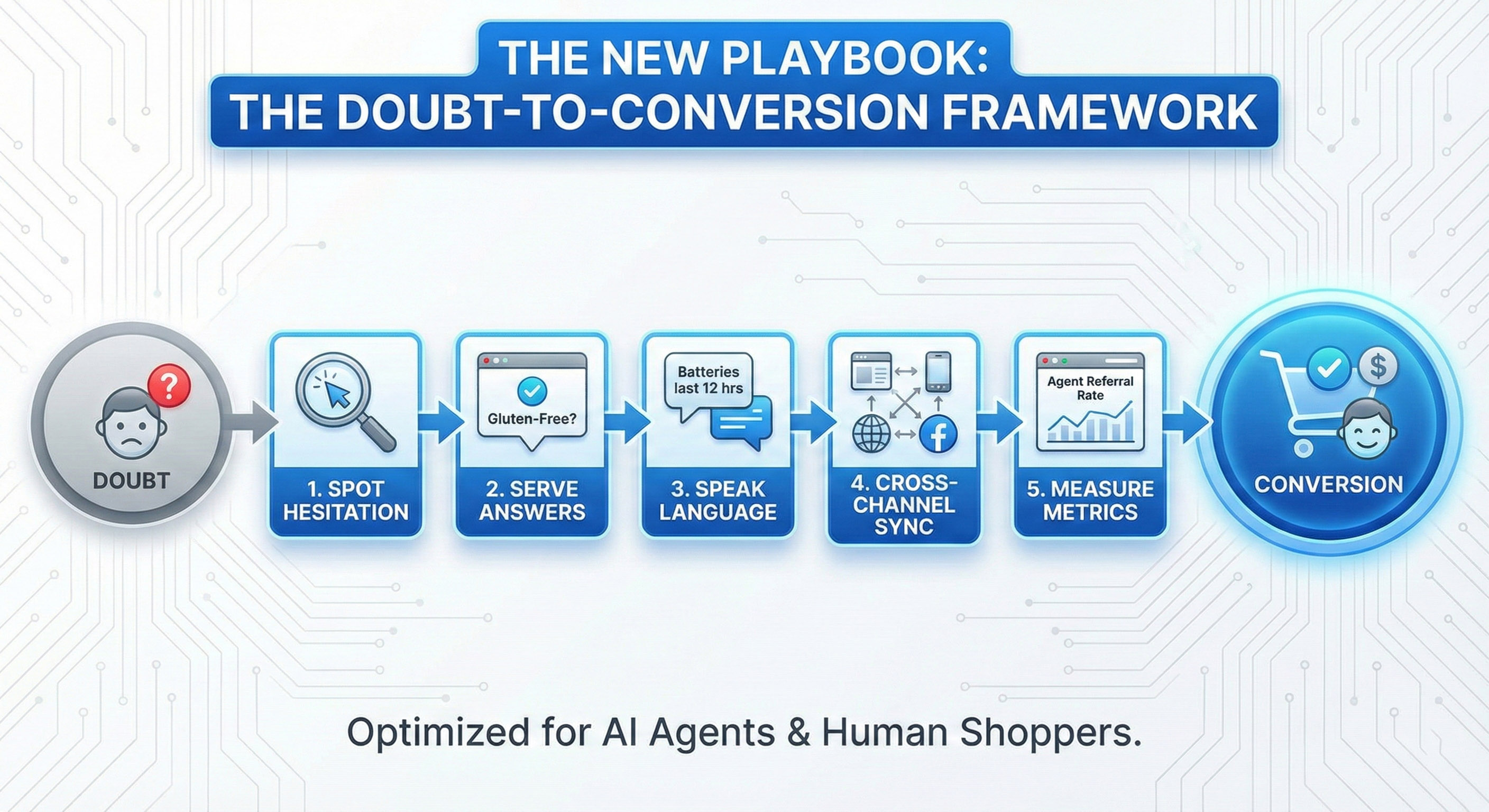
Here are the 5 steps to implement the framework, shown through a healthy snack brand as an example:
1. Spot the Hesitation (Intent Signal Detection)
Stop guessing why people leave. Use your data to find the “hesitation moments.”
- The Action: Monitor real-time browsing behavior. If a user hovers over the “Ingredients” tab for 10 seconds, they have a nutritional doubt. If they flip between a 6-pack and a 12-pack, they have a price-match doubt.
- The Goal: Pinpoint the moment a customer hesitates.
2. Serve the Right Answer (Contextual Content Triggers)
Once you know the doubt, hit them with the answer immediately.
- The Action: Stop making them search for info. When the AI sees a nutrition doubt, it should instantly display a ‘Keto-Friendly’ or ‘Zero Sugar’ highlighted in line of sight.
- The Goal: Kill the specific doubt before it kills the sale.
3. Speak the Customer’s Language (Semantic Matching)
AI agents search for meaning, not just keywords.
- The Action: Rewrite your product descriptions to answer natural language questions. Instead of just listing “15g protein”, use phrases like: “This is the best high-protein snack for busy parents who need a clean energy boost.”
- The Goal: Ensure your product is the first thing the AI suggests when a customer asks for help (e.g., “What is a healthy snack for toddlers that won’t cause a sugar crash?”).
4. Ensure Consistency Everywhere (Cross-Channel Sync)
An agent checks multiple sources to verify your data before recommending you.
- The Action: Ensure your product details, like protein counts and allergy certifications, match across your website, mobile app, and social media pages.
- The Goal: Establish your snack as a credible choice so the AI highlights you as a reliable recommendation.
5. Measure What Matters (Outcome-Based Analytics)
Just looking at ‘page views’ won’t tell you if an AI or a person believes your product data.
- The Action: Track “Doubt Resolution Rate” (measuring how many people buy once their specific concerns are answered) and “Agent Referral Rate” (tracking customers who find your product through an AI recommendation).
- The Goal: Convert conversations into customers. Brands investing in this approach see a 12–25% rise in completed orders over a 12-month period [4].
The Reality Check: Can You Scale This?
Implementing this framework across hundreds of SKUs manually is impossible. However, the risk of doing nothing is even higher. If your products aren’t showing up in AI suggestions, you’re losing sales without even realizing it.
That’s where enaiblex comes in.
Our E-Commerce Product Details Optimization service is built for the new AI era. You get high-performance product pages designed to convert two audiences: human shoppers and the AI shopping agents that recommend you.
Get crystal-clear product descriptions and high-quality visuals that AI agents can easily read, trust, and rank—driving better visibility and more sales across your entire catalog.
Final Takeaway: Turn Your Catalog into Your Best Salesperson
The brands that win in 2026 won’t be the ones with the loudest ads. They will be the ones that make it easiest for AI agents to understand, trust, and recommend their products.
The data proves it: well-organized content lets you launch and sell new products 25–40% faster, and by using standardized templates, you also eliminate 40–60% of the outdated information [2]. Hence, moving away from a static catalog and making your products AI-ready attracts more visitors and converts them into sales on every page.
Citations
- Conversational commerce adoption and brand visibility, LinkedIn, 2025. [1]
- Information discovery and content governance in e-commerce, arXiv, 2024. [2]
- Predictive modeling and purchase prediction accuracy, PubMed Central, 2024. [3]
- E-commerce bounce rates and customer experience expectations, EcommerceTimes, 2023. [4]
Note: This article was compiled by our specialized content agent, which analyzed 4 key industry sources and was overseen by human experts to ensure accuracy.