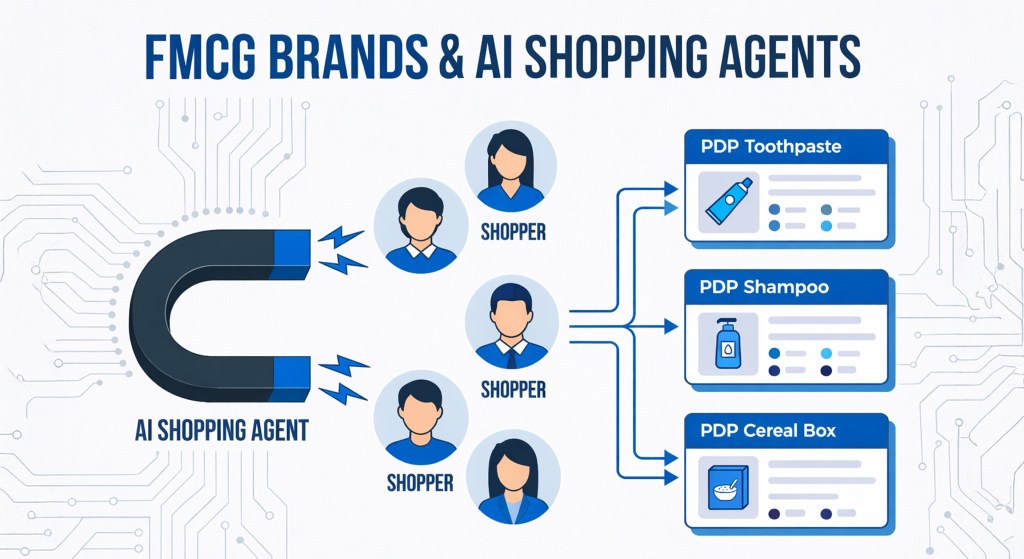
The era of the static product page is over. As we move deeper into 2026, the most critical question for brands is no longer just about Google rankings—it is this: Is your e-commerce content ready for AI shopping agents?
To answer that, we must first define the battlefield. In this context, e-commerce content isn’t just marketing copy; it is the structured data that lives on your Product Detail Page (PDP). Your PDP is now the single source of truth for AI. If that content isn’t structured for machines, your products effectively don’t exist in the new AI economy.
In early 2025, a leading CPG manufacturer watched its organic traffic flatline despite holding top Google rankings. The problem was not an SEO penalty. It was a platform shift.
AI shopping agents became the new gatekeepers.
Shoppers were asking tools like ChatGPT or Gemini specific questions (e.g., “vegan protein powder without stevia that mixes well in coffee”). The agents recommended products whose PDPs answered that exact question. The brand’s keyword-heavy PDPs did not.
Adobe Analytics captured the trend: visits from generative AI sources to retail sites jumped 1,200% YoY by March 2025 and reached 4,700% by July 2025.
To survive this shift, you must treat your PDP like a decision document, not a billboard.
Fast Track: Key Takeaways
- The Problem: AI agents reject vague claims. If you are ambiguous, you are invisible.
- The Solution: Use Generative Engine Optimization (GEO) to structure your PDP content for machines.
- The ROI: Brands that optimize for “Task Completion” now will own the next $750B in consumer spending.
The Reality Check: Optimize for Task Completion, Not Keywords
Most brands still build Product Detail Pages (PDPs) like static SEO landing pages. AI agents, however, treat them like a fact base they can trust, compare, and cite.
If your PDP is vague, the agent skips it. If your claims are unclear, the agent removes you from the shortlist—no matter how strong your Google ranking looks.
- 39% of consumers already use AI for product discovery.
- 70% of global shoppers want AI tools to simplify decisions.
- 24% of orders are now influenced by AI recommendations.
What wins: Clear, verifiable answers to real buying questions.
What loses: Repeated keywords and fluffy promises.
Example: A PDP that clearly answers “Is this shampoo safe for color-treated hair?” beats a page that simply repeats “color-safe shampoo” ten times.
The Real Constraint: Make Every Claim Specific and Verifiable for AI Shopping Agent
Agents reject ambiguity.
If a shopper asks for “color-safe shampoo for dry scalp,” and your PDP says “revitalizing shine,” the agent has nothing concrete to use. Even worse, vague claims can backfire. If an agent recommends your product based on a fuzzy promise, and reviews contradict it, the agent learns to trust you less over time.
You need Generative Engine Optimization (GEO).
Generative Engine Optimization (GEO) means you structure PDP content so AI models can easily understand it, summarize it, and cite it. Traditional SEO focuses on rankings. GEO focuses on direct answers and machine-readable trust.
The Solution: Run the 4-Step Loop to Make PDPs “Agent-Ready”.
Top FMCG brands are moving away from guesswork. They use a repeatable workflow across every SKU to ensure visibility.

1. PREDICT: Identify the Questions Buyers Ask
Stop guessing keywords. Find the real intent behind high-value queries.
- Do This: Analyze search data, chat logs, reviews, and customer service questions.
- The Outcome: A list of “intent clusters” per SKU (e.g., “Is it gluten-free?” “Does it fit a 15-inch laptop?”).
2. ATTRIBUTE: Place the Facts Where Agents Look First
Agents need data in predictable places.
- Do This: Map each intent cluster to the right PDP section.
- The Outcome:
- Title: Clear category + key variant.
- Description: Short use-case story + key proof points.
- Specs/Tiles: Hard facts (ingredients, dimensions, allergens, certifications).
3. GENERATE: Write for Agents and Humans at the Same Time
You have two audiences on one page.
- Do This: Combine structured facts (agent-friendly) with benefits and brand voice (human-friendly).
- The Outcome: Copy that is factual, specific, and persuasive—without the hype.
4. QUANTIFY: Measure What Actually Changes Outcomes
Old metrics alone will miss the shift.
Track Performance Across Three Lanes:
- Search Visibility: Traditional rankings and traffic.
- Agent Visibility: How often AI tools cite or recommend your SKU.
- Conversion: How effectively content drives purchase decisions.
Implementing this loop across thousands of SKUs is complex. That’s why we built enaiblex to automate this entire workflow, ensuring your PDPs remain constantly optimized for both Agent Findability and Human Conversion.
Click here to see how it works, or simply book a demo and let our team show you where exactly you are losing traffic to competitors today.
From Theory to Traction: 3 Real-World Scenarios
Scenario 1: The Legacy Skincare Brand (Intent Optimization)
- The Problem: A top brand dominated “anti-aging cream” search but saw zero AI agent referrals. Their PDPs used vague marketing copy (“time-defying radiance”).
- The Fix: They rewrote content to answer specific prompts: “What is the retinol percentage for sensitive skin under $30?”
- The Result: Agent-based traffic rose 180% in 90 days by focusing on the Intent-Mapped Content layer.
Scenario 2: The Challenger Snack Company (Structured Data)
- The Problem: A plant-based startup was ignored by AI agents because serving sizes were hidden in images (which LLMs struggle to read accurately).
- The Fix: They restructured their data so AI agents could instantly read nutrition facts, USDA Organic certifications, and inventory levels. They also triggered a creator campaign to generate verifiable reviews.
- The Result: They became the top recommendation for “vegan protein snacks for kids,” driving a 35% increase in conversion rate.
Scenario 3: The Over-Optimizer (Governance Failure)
- The Problem: A beverage brand spammed schema markup with 200+ attributes, many of which were inaccurate.
- The Consequence: Agents initially indexed them but dropped them after detecting high return rates and mismatched claims.
- The Lesson: More data isn’t better data. Agents reward accuracy and consistency above all.
Strategic Roadmap: Execute These 3 Actions in the Next 90 Days
1. Rewrite Your Top PDPs to Answer Real Questions
- Do This: Review your top 10 PDPs and rewrite the first 200 words to answer the most common buyer questions clearly.
2. Add the Missing Facts Agents Need to Recommend You
- Do This: Make sure each PDP explicitly states the “decision facts” (ingredients, sizes, compatibility, delivery timing, certifications).
3. Increase Trusted Reviews with Real-World Detail
- Do This: Set a monthly program to generate 15–20 high-quality reviews per SKU.
- Aim for: Detail and verification, not generic praise.
Metrics That Predict AI Agent Success
Metric Type | KPI to Track |
Leading Indicators | Zero result rate in internal search (<5%) Schema validation score (Target 100%) Third-party review volume growth |
Lagging Indicators | Agent-referral traffic share Conversion rate from AI sources Return rate differential (Agent vs. Organic) |
Trust Signals | Positive sentiment skew (+70%) Content staleness rate (<2% outdated claims) |
The Bottom Line: Own the Negotiation
The era of “set it and forget it” SEO is over. In 2026, your Product Detail Page isn’t just a brochure; it’s a living document that is constantly negotiating with AI agents on behalf of your human buyers.
Here is the new reality:
As AI agents pull answers from everywhere, brands that don’t control their data risk being misrepresented—or worse, ignored.
Your Move:
Don’t try to boil the ocean. Start with a single product line.
- Apply the Predict-Attribute-Generate-Quantity
- Measure the lift in Agent Findability for 30 days.
- Iterate and scale.
The market is shifting fast. AI search will drive $750 billion in spending by 2028—and the brands that make their products easy for agents to find will take the lead.
Note: This article was compiled by our specialized content agent, which analyzed key industry sources and was overseen by human experts to ensure accuracy.